


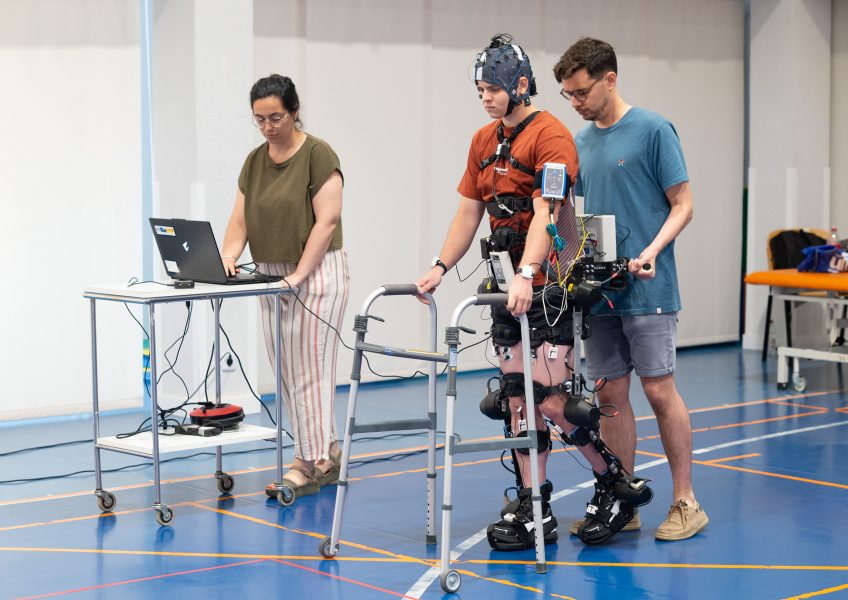
The ReGAIT project has recently appeared in several national media outlets. This initiative explores new strategies for gait rehabilitation in people with incomplete spinal cord injury. For Technaid, this news has special value. Our mobile Exo-H3 exoskeleton is part of the system used at the National Hospital for Paraplegics in Toledo.
The project aims to combine robotics, neural interfaces and spinal cord stimulation. With this approach, the team seeks to connect the patient’s motor intention with robotic assistance. In addition, the system includes transcutaneous spinal cord stimulation. This combination may open new lines of work in neurorehabilitation.
ReGAIT project and neural gait control
One of the most relevant elements of the ReGAIT project is the use of neuro-machine interfaces. These interfaces can detect signals linked to movement intention. To do this, the team works with recordings such as electroencephalography and electrospinography. Then, the system uses this information to synchronize robotic assistance with the patient’s activity.
This approach goes beyond conventional assisted walking. The goal is not only to move the legs with mechanical support. The proposal seeks active user participation during therapy. Therefore, synchronization between neural signals, the exoskeleton and stimulation becomes a key factor.
The role of Exo-H3 in the research
In this research, Exo-H3 provides a lower-limb robotic platform for gait analysis and assistance. Its design allows researchers to work with different control and data acquisition protocols. It can also integrate with external sensors and biomechanical analysis systems. This makes it a useful tool for groups studying new robotic therapies.
In projects like this, objective measurement is essential. Researchers do not only need to know whether the system generates a gait pattern. They also need to measure how the patient’s biomechanics change. Likewise, it is important to study the nervous system response during therapy.
Technology for more personalized rehabilitation
ReGAIT brings together Universidad Miguel Hernández de Elche, Institut Guttmann and the National Hospital for Paraplegics in Toledo. This collaboration combines engineering, neuroscience and clinical experience. As a result, it creates a strong environment to move experimental solutions towards real therapeutic settings.
At Technaid, we are glad to see Exo-H3 contributing to high-impact research in robotic rehabilitation. Projects like this reinforce the importance of open, flexible platforms designed for research. We will continue to follow the evolution of ReGAIT and its potential impact on functional recovery in people with spinal cord injury.
More info: https://bmi.umh.es/portfolio-item/regait/