


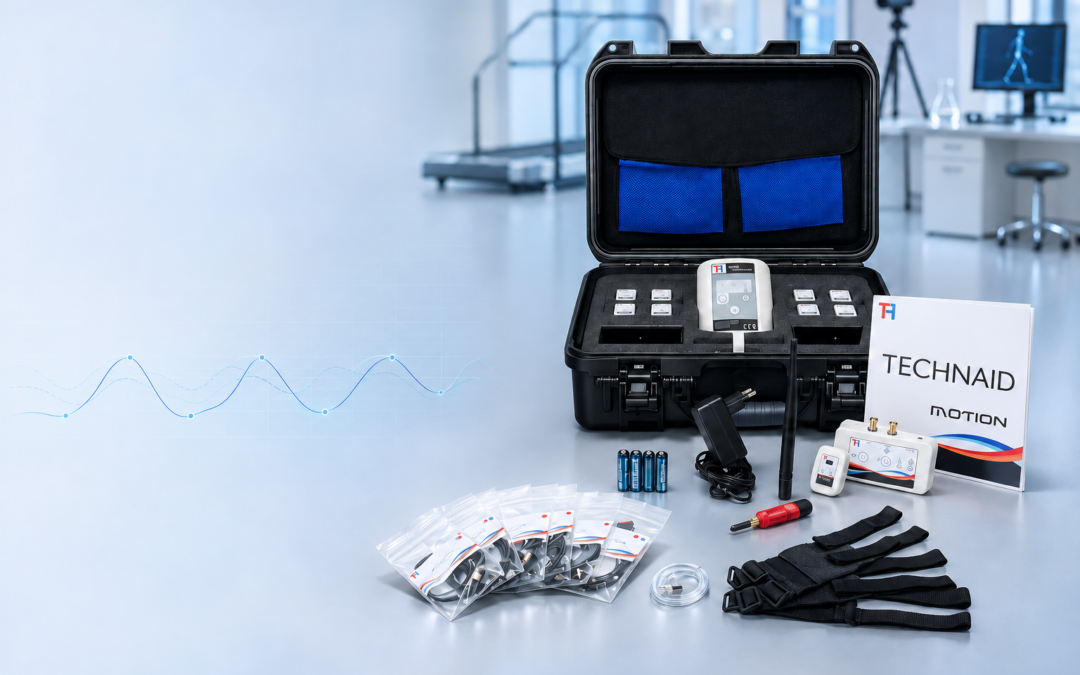
How reliable is inertial motion capture for gait analysis when compared with traditional optical systems? This question remains central to biomechanics and rehabilitation research. Although optical motion capture provides highly accurate measurements, its use often requires controlled laboratory environments. In contrast, inertial measurement units (IMUs) offer portability, flexibility and fewer restrictions during movement. However, researchers must assess their accuracy before using these measurements in experimental or clinical studies.
A study published in Frontiers in Bioengineering and Biotechnology addresses this challenge through a systematic comparison of both technologies. Blanco-Coloma and colleagues evaluated the reliability of inertial sensors using synchronous gait measurements. Their research involved the Tech-MCS motion capture system developed by Technaid and a Vicon photogrammetry system. The results provide valuable evidence for researchers working with wearable sensors, biomechanical assessment and robotic rehabilitation.
Scientific Validation of Inertial Motion Capture
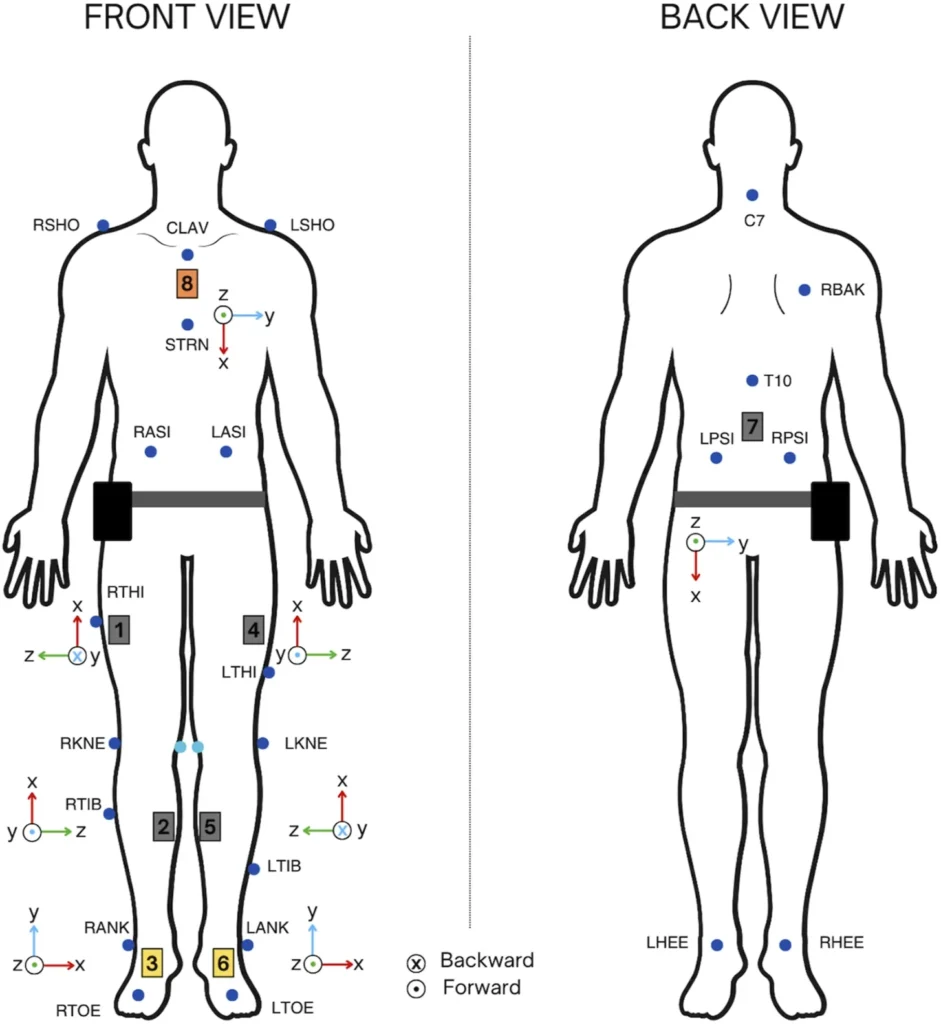
The researchers recorded gait data from 32 healthy participants using both systems simultaneously. Each participant wore eight Tech-MCS IMUs and a configuration of passive optical markers. The team then compared joint kinematics across different anatomical planes. Their analysis included Pearson correlation, root mean square error (RMSE), range of motion differences and the interprotocol coefficient of multiple correlation (CMC).
The results revealed strong correlations for several lower-limb movements. Hip flexion and extension achieved CMC values above 0.90, while knee flexion and extension exceeded 0.95. Furthermore, ankle dorsiflexion and plantar flexion showed high waveform similarity before offset correction. These findings support the potential of inertial motion capture for gait analysis in selected biomechanical applications. Nevertheless, reliability varied depending on the joint movement and the correction methods applied.
An important contribution concerns sensor calibration and positioning. The researchers demonstrated that anthropometric adjustments improve the recording of joint ranges of motion. However, appropriate calibration remains essential to reduce measurement offsets. Therefore, standardized instrumentation protocols are necessary to ensure consistency between participants and experimental sessions. This consideration becomes particularly relevant in longitudinal rehabilitation studies.
Beyond the Laboratory: Opportunities for IMU-Based Research
Optical motion capture remains a reference technology for detailed biomechanical assessment. Nevertheless, camera-based systems present limitations related to marker occlusion, recording volume and environmental constraints. Inertial mocap systems offer a complementary approach by enabling measurements outside conventional laboratories. Consequently, researchers can investigate movement under conditions that are difficult to reproduce with fixed optical installations.
This flexibility creates opportunities in gait rehabilitation, sports biomechanics and wearable robotics. For example, IMU-based measurements can support the evaluation of movement during robot-assisted training. They may also facilitate experiments involving multiple devices or complex rehabilitation environments. However, researchers must account for sensor drift, calibration errors and anatomical differences when interpreting results. www.frontiersin.org+1
Tech-MCS as a Research Platform
For Technaid, this study illustrates the importance of combining portable hardware with validated measurement methodologies. Our Tech-MCS motion capture system provides researchers with access to inertial measurements, joint kinematics and real-time motion data. In addition, its integration capabilities support custom experimental protocols and synchronization with complementary technologies.
Researchers can also use our Tech-IMU sensors in applications requiring compact and flexible sensing solutions. Available development libraries facilitate integration into MATLAB, C# and ROS-based research environments. These capabilities are particularly valuable when studying human movement alongside robotic devices or physiological measurement systems.
Ultimately, the study reinforces an important conclusion: reliable biomechanical research depends on both measurement technology and experimental methodology. IMU-based systems offer considerable flexibility, but their performance must be evaluated for each application. Scientific validation therefore remains essential for advancing motion analysis beyond controlled laboratory environments.
You can explore the original research in our Publications section